Benjamin DeHass | Fremont, CA
I got off work on a recent Friday itching to just do something. A week of sitting under tight deadlines had become a weight I needed lifted. I had just moved to a new place for the summer, and while driving over the highway I saw Mission Peak in the back of the view. It reminded me of a conversation with my first roommates out here and the goal we set to conquer it. Within two hours, the three of us were at the base from three separate houses, ready to climb.
The planner in me made one appearance. On my way out the door I saw my hiking backpack and ran through an entire packing list; headlamps for everyone, snacks, sunscreen, extra layers for the evening chill. I locked the door and disregarded the list. What came instead was my wallet, my phone, two water bottles, and one headlamp between the three of us.
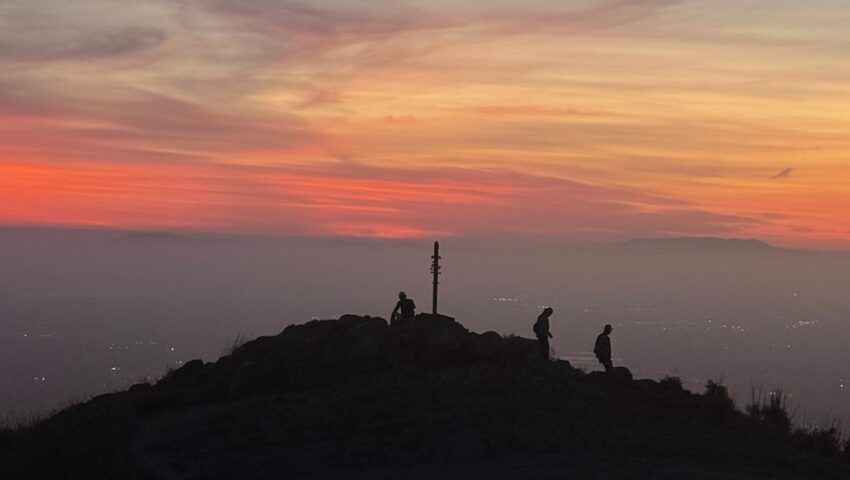
The climb collected on the missing list. The first hour I was burning up, my shirt melting into my back, and by the descent a heavy sweatshirt was not enough. Near the top, we were emboldened by a man being chased down a slope by a cow. If he could run down the mountain, we could finish the walk up it. We reached the peak with less than five minutes of visible sun and stayed thirty minutes, taking in the cities going to sleep across the bay. The walk down is where the list was missed most. One headlamp between three meant that every time its owner turned his head, the rest of us lost our eyes on gravel where a misstep meant slipping or worse.
In optimization, we treat solutions as free once found, but solving has a cost of its own: time to formulate, time to compute, attention spent modeling. That cost is part of the objective whether it is counted or not. It is for this reason nobody runs a full solver on a problem they can answer by looking at it. Small problems are solved by inspection: check the binding constraints (the few limits that decide the outcome, the rest are noise), take the first feasible solution, and execute. Feasible does not mean optimal. It simply means the answer works with what is on hand.
Mission Peak on a Friday evening was solvable by inspection. The constraints fit on one hand; light, water, weather, legs. The check took roughly thirty seconds at the door. Light and warmth came out binding, and we felt both on the way down.
The over-optimized version is the one that concerns me, because the enlargement is entirely self-inflicted. The problem never grows, only the formulation does. The best trailhead, the right moon phase, a weekend that works for everyone, the proper gear. Each added variable feels like diligence, and each is another way for the answer to become not yet. That hike happens in three weeks, or more honestly, never. The planning would not have cost me solve time, it would have cost me the solution.
I wrote before that life can be measured by moments, and that the inter-arrival time between firsts is a measure worth optimizing. Planning overhead works against that measure directly. Every hour spent enlarging a problem is an hour added between me and the next first. The whim, then, was optimization of the measure I had already declared, done at the effort the problem deserved.
The planned version of that night would have been optimal, and it never would have happened. Some nights deserve a solver. This one deserved shoes.